Property data presented in a more meaningful way. Cut through the noise with clear, visual insights that show what's really driving each market.
Melbourne is so large that the entire dwelling stock of Brisbane, Adelaide, Hobart, and Darwin would fit comfortably inside it. Treating "Melbourne" as a single market is a mistake. The data only makes sense once you drill into the markets that sit within it.
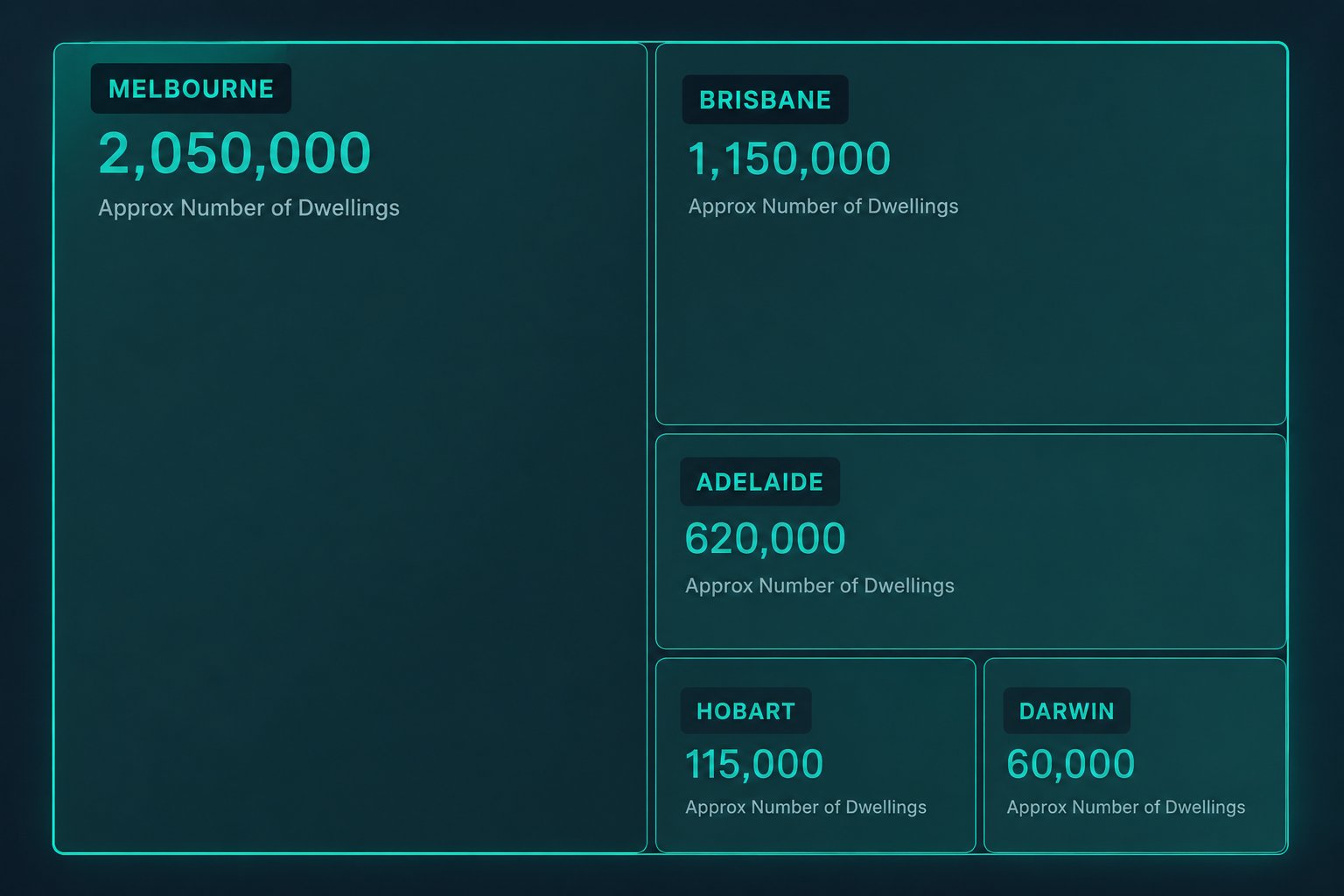
The takeaway: you can't make a single call on "Melbourne". There are markets within the market, and that's where the work happens.
Wondering which market a property really sits in?We read suburbs at the level that actually drives growth.
Book a free callWhen new dwelling supply hits a market faster than demand can absorb it, capital growth stalls. These growth-corridor suburbs sit on top of active development pipelines. They often look attractive on paper, but the supply overhang suppresses long-run prices.
Not sure if a suburb is facing an oversupply?We check the development pipeline before you commit.
Book a free callGross yield is the annual rent divided by the purchase price. It tells you how much of the holding cost the property pays for itself. Buy a strong-growth suburb with weak yield, and the monthly shortfall can force you to sell before the growth ever arrives.
The point: at a 4% yield this property costs over $1,700 a month to hold, before any vacancy or rate rise. A higher yield shrinks that shortfall and lets you hold long enough for capital growth to do its work. We screen every recommendation on both growth and yield, so the numbers stack up the whole way through.
Plug in your own numbers to see the gross yield and the monthly cashflow position. Nothing is stored or sent anywhere. It all runs in your browser.
Enter the deal you're weighing up.
Indicative only. Excludes tax, depreciation, vacancy and rate changes.
Want help running the numbers on a specific property?We pressure-test growth and yield together.
Book a free callTwo checks worth running before any purchase: how much public housing surrounds a property, and what the land underneath it is actually worth. Here's where to find both.
A high concentration of public housing nearby can weigh on long-term capital growth. This map shows public housing percentages by area. Enter a suburb or address to check.
Open the public housing mapLand is what appreciates, so knowing the land value matters. The process differs by state. Here's where to look in each.
Once you've done your research and you're ready to make an offer, send this to the sales agent. Copy it, fill in your details, and email it through.
| Please find below our offer for the property advertised: | |
|---|---|
| Property Address | |
| Offer Amount | |
| Deposit | |
| Names on Contract | |
| 1 – Name | |
| 1 – Address | |
| 1 – Mobile | |
| 1 – Email | |
| 2 – Name | |
| 2 – Address | |
| 2 – Mobile | |
| 2 – Email | |
| Trust / Company / SMSF | Check with your accountant on how to put on contract if purchasing via any of these entities |
| Conveyancer Details | |
| Conveyancer Name | |
| Conveyancer Address | |
| Conveyancer Tel No. | |
| Conveyancer Email | |
| Conditions | |
| Finance Clause | |
| Building & Pest Inspection Clause | |
| Settlement Date | |
Could you please send through the contract of sale so we may submit a formal offer to be considered by the vendor?
Short, practical guides for buyers, covering the homework, the rules, and the day itself.
A tickable checklist covering inspections, contract, location, budget and settlement before you buy the home you'll live in.
Open the checklistCritical for Melbourne and Sydney buyers: why auctions are unconditional, how to prepare, and what happens on the day.
Read the guideState-by-state cooling-off periods, when insurance risk passes to you, and the standard building, pest and finance timeframes.
View the tablesA 12-step roadmap through finance, conveyancing, settlement and (for investors) getting a tenant in. Plus two pro tips.
Follow the steps